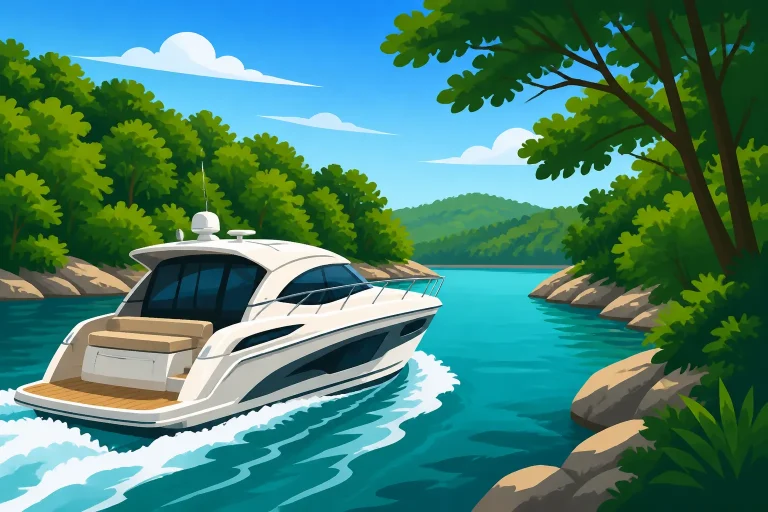
Lake of the Ozarks Speed Limit: Is There One During the Day?
A fast run across open water can feel straightforward until you reach a crowded channel, a dock-lined cove, or a patch of rough chop. At Lake of the Ozarks, there is no single numerical daytime speed limit for boats—but that does not mean every speed is legal or sensible. Here’s how the rule works, when specific limits apply, and how to choose a speed that protects people and property.
Is there a daytime speed limit on Lake of the Ozarks?
No. Missouri does not set a numerical statutory or regulatory daytime speed limit for boats on Lake of the Ozarks. There is no general daytime mph number that applies everywhere on the lake.
Instead, Missouri law requires boat operators to travel at a speed that is careful and prudent under the circumstances and does not endanger life or property. That standard applies even on a bright, calm day in open water. A speed that might be manageable in one place can be unsafe in a congested cove or among smaller boats.
Specific restrictions still matter. Missouri law sets a 30 mph limit at night, and slow-no-wake speed applies within 100 feet of docks, piers, occupied anchored boats, and buoyed areas. The absence of a general daytime number does not cancel those limits.
| Situation | What to keep in mind |
|---|---|
| Daytime, open water | No general numerical speed limit, but the careful-and-prudent standard still applies |
| Night | A statutory 30 mph limit applies |
| Within 100 feet of a dock or pier | Slow-no-wake speed applies |
| Within 100 feet of an occupied anchored boat | Slow-no-wake speed applies |
| Within 100 feet of a buoyed area | Slow-no-wake speed applies |
That is the essential distinction: no blanket daytime speed cap, but speed is still regulated by conditions and location. Operators need to judge what is reasonable for the water and traffic in front of them, then slow down when the law or circumstances require it.
For a fuller explanation of the general standard, see Careful and Prudent: What Missouri Law Means by Safe Boat Speed. If you want to understand the specific reduced-speed rule, Slow-No Wake Speed in Missouri: What the Law Means by It explains that topic separately.
What “careful and prudent” means in practice
“Careful and prudent” is not a speedometer setting. It asks the operator to account for the conditions rather than rely on one number that supposedly works everywhere. The basic question is not simply, “How fast can this boat go?” It is, “Can I maintain control and avoid creating a danger at this speed, here and now?”
A boat’s safe speed can change within a short distance. The open main channel may give an experienced operator room to travel faster than a narrow, busy cove. A boat that handles smoothly in calm water may become harder to control when wakes cross from several directions. A speed that seems comfortable when the boat is lightly loaded may feel very different with passengers and gear aboard.
Practical factors to consider include:
- Traffic: More boats mean more chances of crossing paths, sudden turns, and unpredictable movement. Leave enough time and room to react.
- Visibility: Darkness, glare, rain, spray, or a low view from the helm can make it harder to spot boats, swimmers, markers, or floating objects.
- Water conditions: Chop and intersecting wakes can affect control, particularly for smaller craft or boats with passengers who are not prepared for a rough ride.
- Nearby people and property: Docks, swimmers, anchored boats, and other vessels call for extra caution. Some of these locations also trigger the specific slow-no-wake rule within 100 feet.
- Your boat and its load: Handling varies by hull, engine, weight distribution, and passenger placement. Do not assume another operator’s pace is appropriate for your boat.
- Your ability to respond: If you cannot see far enough ahead or leave room to slow, turn, or avoid a hazard, your speed may be too high for the situation.
These are practical indicators, not a separate list of legal speed limits. They help an operator apply the careful-and-prudent standard in real conditions. For example, a boat traveling at a moderate speed through a crowded area may still be going too fast if the operator cannot respond safely to a person entering the water. Conversely, the law does not supply a universal daytime mph ceiling for every stretch of open water.
A common mistake is to treat “no daytime limit” as permission to maintain a preferred speed wherever the boat can physically achieve it. The rule is not a guarantee that a particular speed is acceptable because the water looks open at first glance. Conditions can change ahead, and operators need to adjust before a situation becomes difficult.
It is also risky to treat another boat’s speed as a reliable guide. That operator may have a different boat, a different view, or different experience. They may also be making a poor decision. Your responsibility is to operate your own vessel safely and comply with the applicable rules.
When a trip includes passengers who are new to boating, explain that speed and wake are connected to comfort and safety, not just travel time. Ask them to remain seated where appropriate and tell the operator if conditions are making them uncomfortable. For a broader look at safe spacing, How Far to Stay From Docks, Swimmers and Other Boats in Missouri offers useful context.
Where the 100-foot slow-no-wake rule applies
The absence of a general daytime speed limit does not mean you can travel at any speed near shore or around other vessels. Missouri law requires slow-no-wake speed within 100 feet of docks, piers, occupied anchored boats, and buoyed areas.
The rule is tied to both distance and location. If your boat is within 100 feet of one of the listed features, the reduced-speed requirement applies. It is not limited to nighttime, and it does not disappear just because the rest of the lake is open.
This is particularly relevant when moving through dock-lined stretches or entering and leaving a cove. Operators may focus on the route ahead and overlook a dock or anchored boat off to the side. Keep track of the distance to nearby features, and reduce speed in time rather than waiting until you are already close.
Buoys also deserve attention. A buoyed area may signal a place where you need to change how you operate. Do not assume a marker is decorative or that the absence of a posted mph number means you can ignore the area. Pay attention to markers, keep a safe lookout, and make sure your route and speed fit the conditions.
The rule is not the same thing as a general speed limit for the entire cove or lake. It applies within the stated distance of the listed features and buoyed areas. Other circumstances may still require you to slow down under the careful-and-prudent standard, even if you are outside that 100-foot zone.
If you are approaching a dock or occupied anchored boat, consider the full situation, not just the distance. Someone may be preparing to board, swimming nearby, or moving between a vessel and shore. A wake can affect people and property beyond the boat that creates it. Reducing speed early gives you more time to maneuver and helps avoid a last-second correction.
For more detail on the law’s distance requirements and related situations, see Dock and Swimmer Distances: When Missouri Boaters Must Slow to No Wake. Passing Docks in Missouri: How Slow Is Slow-No Wake? is also useful when you are trying to understand how to handle a dock-lined route.
What changes after dark
At night, Missouri’s statutory 30 mph limit applies. That is different from the daytime rule: daytime has no general numerical speed limit, while the night rule gives a specific maximum. The careful-and-prudent requirement remains relevant, so staying below 30 mph does not automatically make every nighttime speed safe.
Visibility and reaction time are major concerns after dark. It can be harder to judge the distance and movement of other boats, recognize a person in the water, or notice an object ahead. Glare from shore or other vessels can also make it harder to pick out what is on the water. Conditions that feel manageable during the day may call for a much slower pace at night.
Do not confuse the nighttime maximum with a recommended cruising speed. It is a legal ceiling, not a target. If visibility is poor, traffic is close, or the water is rough, a prudent operator may need to travel well below that limit—or pause the trip if continuing would be unsafe.
The 100-foot slow-no-wake requirement does not become irrelevant at night. The specific rule still applies near docks, piers, occupied anchored boats, and buoyed areas. In those places, the applicable slow-no-wake requirement takes priority over the idea that the general nighttime maximum is permissible everywhere.
Night trips also call for careful attention to the boat’s required navigation lights and to what other vessels are displaying. If you are preparing for an after-dark outing, review Boating After Dark in Missouri: Lights and Rules for Night Trips and Missouri Navigation Light Rules by Vessel Class. These topics are separate from the speed question, but they affect how well you can see and be seen.
How to choose a safe speed on a busy lake
Lake of the Ozarks can present very different conditions from one part of a trip to another. Instead of choosing one speed at the launch and holding it for the entire outing, reassess as you travel. Think ahead about what is coming up and make speed changes early enough to be smooth and deliberate.
A useful approach is to work through these questions:
- What is around the boat? Look for docks, piers, occupied anchored boats, swimmers, buoyed areas, and moving traffic. If you are within 100 feet of a listed feature, follow the slow-no-wake requirement.
- How much room do I have? A narrow route or crowded area leaves less space for course corrections. If the available room is shrinking, reduce speed before you need to make a sudden move.
- Can I see and react? Consider visibility, glare, spray, and the distance you can actually see ahead. If you cannot spot a developing hazard in time, slow down.
- How is the boat responding? Notice whether wakes or chop are affecting the boat’s control and passenger comfort. Adjust rather than trying to hold the same pace through changing water.
- Who is aboard? Passengers may need more time to prepare for turns or rough water. A speed that feels routine to the operator may be uncomfortable or unsafe for someone who is standing, moving around, or unfamiliar with the boat.
- Is it daytime or night? At night, observe the 30 mph statutory maximum and remember that actual safe speed may need to be lower.
This kind of check is especially helpful when moving from open water toward a marina, cove, or dock area. A gradual reduction in speed is easier to manage than a sharp slowdown made at the last moment. It also gives passengers time to settle and lets other boaters better anticipate your movement.
Wake is another reason to think beyond the speedometer. A boat’s wake can affect smaller boats, people near docks, and vessels at anchor. Even when you are not inside the 100-foot zone, a wake that creates a hazard may be a sign that your speed or route needs to change. The legal test remains the careful-and-prudent standard; practical courtesy helps you make better decisions within it. For related guidance, see Wake Courtesy on Missouri Lakes: Rules and Common Sense.
Busy weekends call for extra patience. When traffic is dense, avoid following another boat so closely that you have no time to respond. Keep a steady lookout rather than focusing only on the boat directly ahead. If you need to change course or slow down, do so in a way that is predictable and gives nearby operators time to react.
Do not let schedule pressure make the decision for you. If reaching a destination quickly would require running too fast for current traffic or visibility, allow more time instead. If the route feels uncomfortable, choose a calmer path or wait for conditions to improve. A flexible plan is safer than treating a preferred arrival time as fixed.
A practical checklist before and during your trip
Before leaving the dock, make sure the person operating the boat understands the difference between the daytime standard and the specific limits. A simple briefing can prevent confusion when someone asks, “What is the speed limit here?” The useful answer is not “anything goes.” It is: no general numerical daytime limit, but operate carefully and prudently, observe the 100-foot slow-no-wake rule, and follow the nighttime limit when it applies.
A few habits make that easier:
- Review the route: Identify narrow or busy stretches, dock-lined areas, and places where buoys may affect how you should proceed.
- Agree on who is operating: Avoid uncertainty about who has the helm, especially when passengers are moving around or the boat is approaching a crowded area.
- Keep a lookout: Assigning a passenger to help watch for hazards can be useful, but the operator remains responsible for paying attention.
- Slow down early: Reduce speed before reaching a dock, pier, occupied anchored boat, or buoyed area where the slow-no-wake requirement applies.
- Reassess after conditions change: Traffic, visibility, and water conditions can shift during one outing. Check them repeatedly instead of relying on the conditions at departure.
- Plan night travel carefully: Know that the 30 mph nighttime maximum applies, and choose a lower speed whenever visibility or traffic calls for it.
- Leave room for mistakes: Give yourself enough time and distance to respond to a boat changing direction, a person entering the water, or an unexpected obstacle.
Education can help operators recognize how general rules apply in changing situations. BoaterExam can be a way to review boating-safety concepts, but an online lesson does not replace reading current Missouri requirements or using sound judgment on the water. If you are unsure whether you meet the state’s education requirements, consult Who Needs a Missouri Boater Safety Card? Birth Years and Boat Sizes and Which Online Boater Safety Courses Does Missouri Actually Accept?.
Equipment matters too, but gear cannot compensate for an unsafe speed. Before heading out, check that required safety equipment is aboard, accessible, and appropriate for the vessel and passengers. West Marine may be one place boaters look for general boating supplies, but confirm that any equipment you buy meets the requirements that apply to your boat. For a Missouri-focused gear review, see Missouri Boat Safety Equipment Checklist.
If you are stopped or questioned about your operation, avoid assuming the absence of a daytime mph limit settles the issue. The relevant question may be whether the boat was being operated carefully and prudently in the actual conditions, or whether a specific restriction applied because of location or time. A calm, clear understanding of the rules is more useful than arguing from a single number.
The practical takeaway is straightforward: during daylight, Missouri does not impose a general numerical speed limit for boats on Lake of the Ozarks. But operators must still choose a speed that does not endanger life or property, slow to the required level within 100 feet of the locations specified by law, and observe the 30 mph limit at night. Treat speed as a decision that changes with the water—not as a number to set once and forget.
Disclaimer
This article is for general informational purposes only and does not constitute professional advice. Laws, prices and regulations vary by location and change over time. Consult a qualified professional for guidance on your specific situation.